Knowledge Base
Verifying a Drawing
Draft and verified
Every drawing carries one of two states, shown next to its title.
A hand-drawn schematic starts verified, because somebody drew it deliberately. Anything machine-produced, from a DXF import or generated from asset data, starts as a draft and says so, because nobody has looked at it yet.
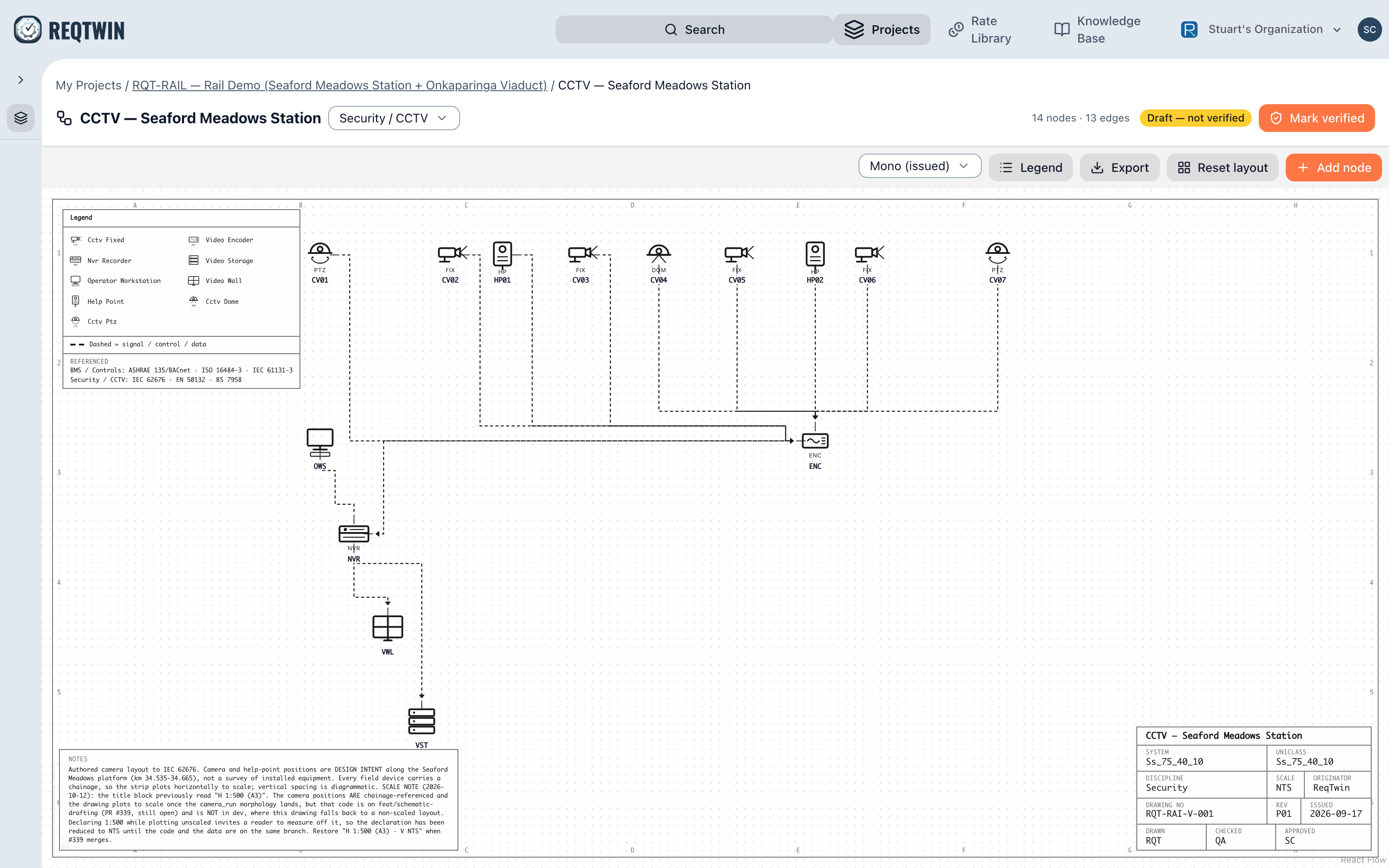
A CCTV camera run in its draft state, with the basis of preparation stated on the sheet and a Mark verified action.
Mark verified clears the gate and records who cleared it and when. Reopen as draft puts it back, which is what you do when a drawing has been edited enough that the previous review no longer covers it.
What the drawing states about itself
A drawing can carry its own basis of preparation: where its geometry came from, what was corroborated against what, and what it deliberately does not show.
The signalling plan states which open data its chainages were measured from, which published table its signal designations came from, that the territory is axle-counter worked so there are no track circuits to draw, and where connectivity was inferred rather than surveyed, that it was inferred and from what. A reader knows what they are looking at and, just as importantly, what they are not.
That last point is the one worth keeping. An inferred connection drawn identically to a measured one is a drawing telling you something it does not know.
What gets checked
Three things are checked, and they answer different questions.
Topology. Nothing is orphaned, nothing is drawn detached from the plant it serves, no two symbols are stacked on one point, no connector names a symbol that is not on the drawing, and symbols that terminate a run have exactly one connection. These are the defects that look like a finished drawing: a floating buffer stop, or a depot drawn as an island, is invisible by eye and obvious by degree.
Geometry. No connector crosses a symbol body, and no two symbols overlap. A line through a symbol reads as a connection that is not there, with one exception that matters on a track plan: a track legitimately passes the symbols standing on it. A signal on its own road is not an obstacle to that road.
Rendering. Every arrow arrives head-on at the symbol it serves and stops short of it by a consistent gap. An arrow arriving side-on leaves which symbol it serves ambiguous.
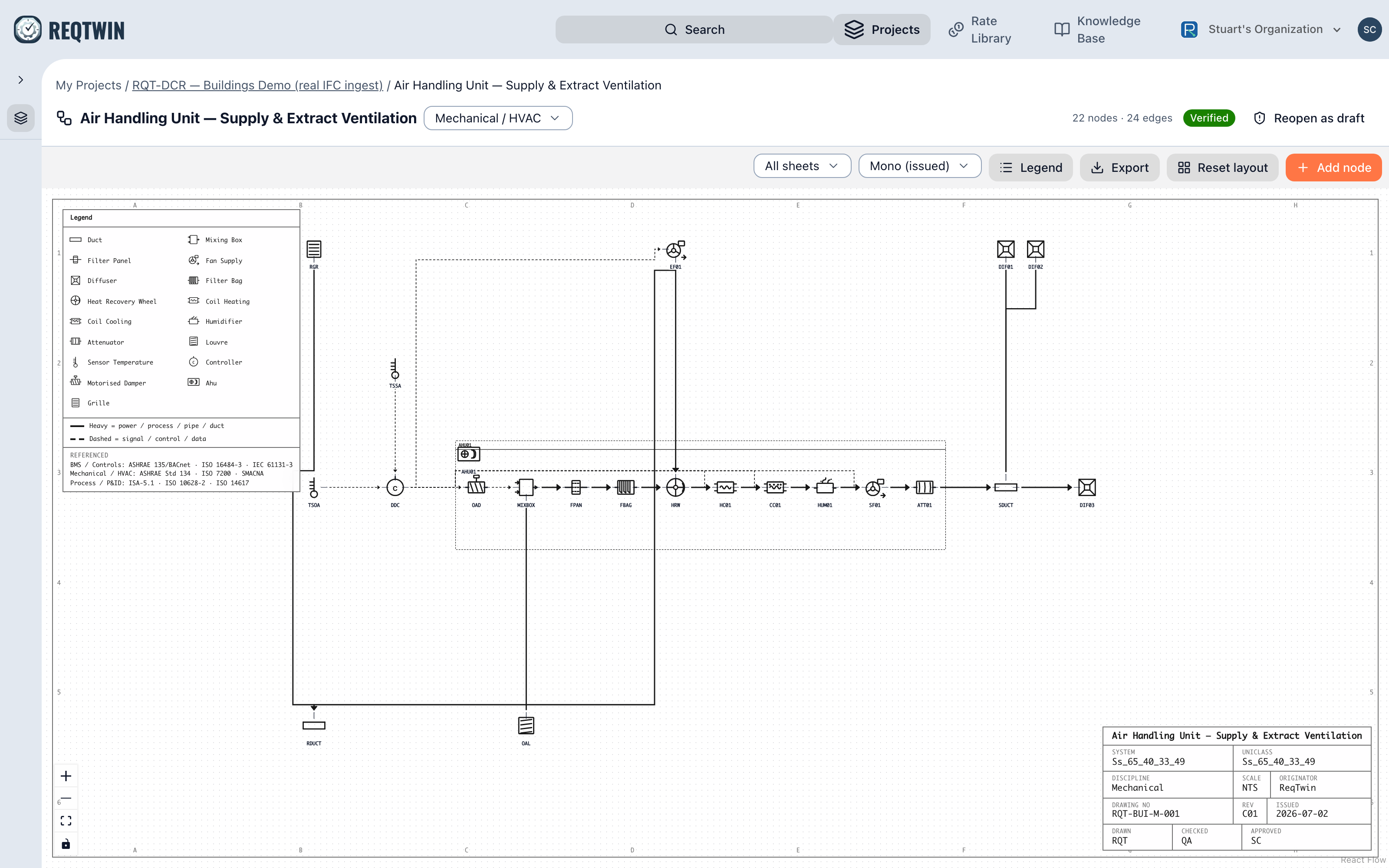
An air handling unit: the cased train with its connectors routed around the slices rather than through them.
The checks run against what you see
A check that models different geometry from the renderer is not a check. The gate draws each connector the way the canvas draws it (including track, which is not routed but run along its road) so a figure it reports is a figure you can find on the sheet.
What verification does not mean
Marking a drawing verified says a person has looked at it. It does not assert that every symbol conforms in detail to the figure its discipline's standard prescribes; that is a separate conformance question, and the basis of preparation is where a drawing states its position on it.
Related
Schematic Drawings covers the disciplines and how each is laid out.
Drawing to a Standard covers the sheet frame, title block, scale and legend.